Executive summary
Specialty therapies used to treat inflammatory diseases—including rheumatoid arthritis, psoriatic arthritis, Crohn’s disease, and ulcerative colitis—are among the most expensive treatments covered under pharmacy benefits. Although they account for a small portion of overall prescription claims, they contribute disproportionately to pharmacy spending.
To manage this challenge, Scripius implemented a targeted strategy focused on achieving the lowest possible net drug cost for clients and their members. Between January 2022 and October 2025, Scripius reduced per member per month (PMPM) spending in the inflammatory biologics category from $25 PMPM to $20 PMPM for commercial plans following Scripius utilization strategies[1]. Importantly, these figures represent net cost inclusive of manufacturer rebates and are not adjusted for inflation. The real impact of these savings is likely even greater.
Why inflammatory specialty drugs drive pharmacy cost trends
Inflammatory specialty drugs treat chronic autoimmune conditions that require ongoing therapy and careful clinical management. These therapies are often administered through injections or oral formulations and can cost tens of thousands of dollars per patient annually.
For every 1,000 pharmacy claims across all disease states, roughly five claims may fall within the inflammatory specialty category. Yet their financial impact is significant because of their high per-patient cost.
For employers and health plans seeking to manage pharmacy trends, strategies that address these high-cost categories can meaningfully influence overall spending.
The lowest net cost approach
Scripius approaches pharmacy benefit management with a guiding principle: prioritize the lowest net drug cost. Biosimilar adoption is one strategy; others include direct manufacturer contracting, focused clinical and utilization management, and advanced analytics to guide decision making.
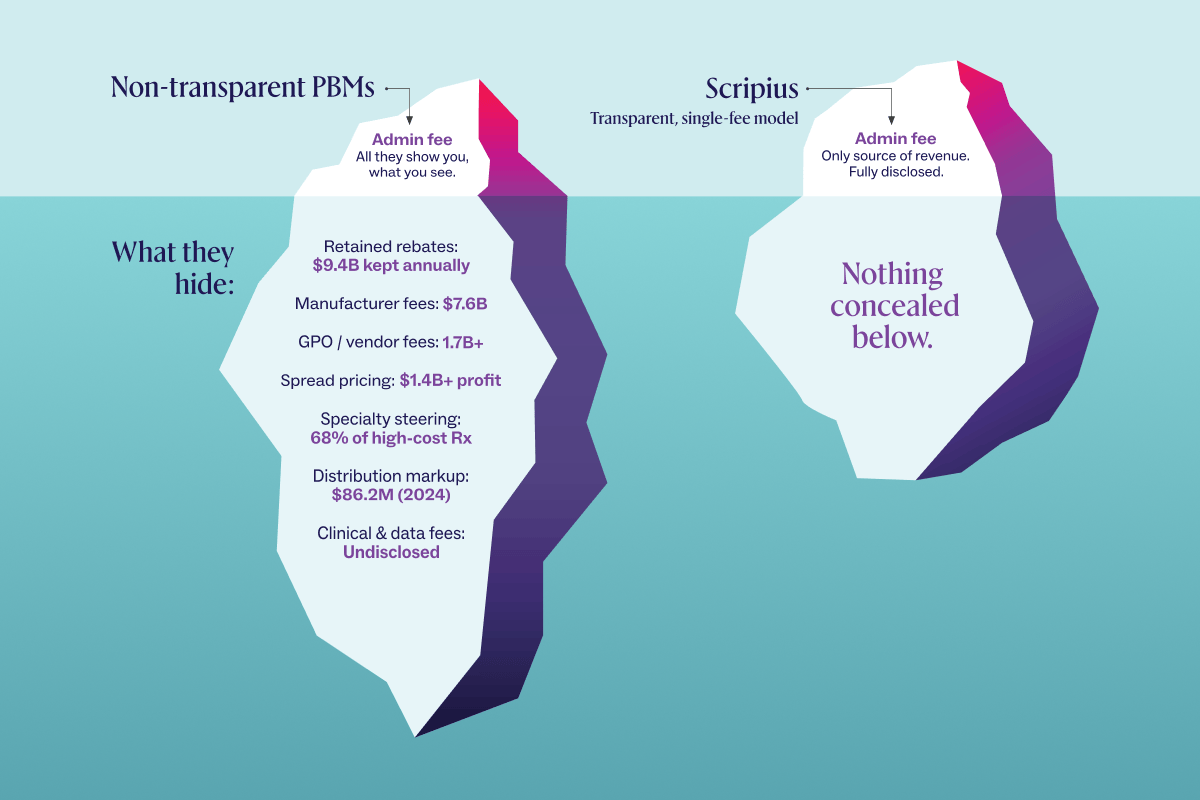
Rebates remain part of the strategy. However, rebates do not always translate into lower overall drug costs for plans or members. And, traditional rebate structures can make drug pricing opaque to employers and health plans, since rebates are paid after the point of sale and often involve multiple intermediaries.
Instead, Scripius evaluates therapies based on their total net cost after rebates, along with clinical effectiveness and supply considerations.
When biosimilars become available, they often offer notable cost reductions compared with reference biologic products. By integrating biosimilars into formularies and managing transitions carefully, Scripius can reduce overall drug spending while maintaining access to clinically effective therapies.
“Cost savings is the only reason to move forward with any biosimilar strategy. Scripius will continue to capitalize on its ability to be very agile in optimizing biosimilar options when savings are available.”
— Matt Mitchell, PharmD, FAMCP, MBA
Chief Pharmacy Officer, Scripius
Biosimilars as a key cost management strategy
Scripius has worked with its clients to replace multiple specialty therapies with biosimilars on its formulary. The experience illustrates how biosimilar adoption can significantly reduce spending in this disease category while maintaining effective treatment options. Below are two high-impact examples.
Humira transition
Humira was historically one of the largest drivers of inflammatory specialty spending for this client, contributing approximately $10 PMPM to category spending before the introduction of biosimilars.
Scripius transitioned coverage to biosimilars Amjevita and Hadlima, reducing Humira-related spending to under $2 PMPM.
Members with a history of Humira use experienced a 50% year-to-date reduction in net allowed costs since 2023.
Stelara transition
Scripius also replaced the reference product Stelara with biosimilars Pyzchiva and Selarsdi. These therapies provide equal clinical effectiveness while offering substantial cost advantages.
In the three-month period of August through October 2025, members with a history of Stelara use experienced a 75% reduction in net allowed costs compared with the same period the previous year.
Together, these actions contributed to the broader decline in PMPM spending across the inflammatory specialty class.
“When biosimilars for biologics like Humira and Stelara became available, we evaluated the total net cost and made the decision to transition quickly. By moving to preferred biosimilars and removing the reference product from the formulary, we were able to significantly reduce spending in this category while continuing to support patient care.”
— Matt Mitchell
Scripius removed Humira from its standard client formularies as of January 1, 2024, and Stelara as of July 1, 2025, extending these PMPM savings across all lines of business for health plan clients.
Implementation process
Executing a biosimilar transition requires careful planning and collaboration. Scripius follows a structured process.
- Monitor drug development pipelines and Food & Drug Administration biosimilar approvals to identify upcoming opportunities.
- Conduct clinical evaluation through the Pharmacy & Therapeutics (P&T) Committee.
- Secure manufacturer contracts and confirm adequate product supply before implementing changes.
- Add biosimilars to the formulary and encourage adoption among prescribers and patients.
- Remove the reference biologic from the formulary while maintaining an exception process for documented clinical need.
“Biosimilar strategies can deliver meaningful savings across multiple payer types. Whether working with Medicaid or commercial plans, lower-cost biosimilars often provide a clear opportunity to reduce specialty drug spending while maintaining access to effective therapies.”
— Matt Mitchell
Protecting access and clinical outcomes
Cost management strategies must preserve access to clinically effective care. For this reason, the Scripius P&T Committee, which includes physicians and pharmacists, reviews and votes on formulary decisions before implementation.
Utilization data indicates that access to treatment has remained stable even as spending declined. The number of inflammatory specialty claims has increased slightly, suggesting that members continue to receive effective therapies despite changes in specific products.
What this means for employers and health plans
For employers and health plans, the inflammatory specialty category illustrates how targeted strategies can influence overall pharmacy spending. By focusing on net drug cost and proactively adopting biosimilars, organizations can control cost trends without compromising clinical outcomes.
The Scripius approach emphasizes transparent pricing, careful clinical oversight, and strategies designed to deliver the lowest possible net cost for plans and members.
Scripius will continue to monitor the biosimilar pipeline to identify new cost-saving opportunities while ensuring continued patient access to effective therapies.
Ready to learn more about how Scripius helps plans manage specialty drug costs? Talk to your pharmacy benefits consultant or contact us.
Email: MakeTheSwitch@Scripius.Org
Call: 801-442-3117
About Scripius
Scripius is revolutionizing the pharmacy benefits management industry with cost-saving strategies that focus on lowering prescription drug costs for self-funded employers, health plans, health systems, and members. For more information, visit Scripius.org.
1. Scripius claims data, commercial fully insured
January 2022 - October 2025, commercial fully insured population
Related Articles